Is there a better way to screen blood?
Wednesday 25th Jun 2025, 12.30pm
What’s the best gift you can give? To the millions of people whose lives have been saved by complete strangers, the answer would be simple: blood. But what exactly happens when blood has been donated, and how do we know it is safe? We chat to Dr Richard Mayne from Oxford’s Experimental Medicine Division about genomics, Next-Generation Sequencing, blood screening (…and Star Trek).
Could you be a blood-donating hero? Blood stocks are currently critically low, with the NHS Blood and Transplant (NHSBT) group in urgent need of new donors. Click here, and you’ll be on your way to saving lives: https://www.blood.co.uk/news-and-campaigns/campaigns/blood-donor-appeal/
Emily Elias: There is a shortage of blood in the UK at the moment. The NHS has put out a call looking for two hundred thousand new donors to come forward. But all of that blood needs to be screened before it heads to the people that need it. On this episode of the Oxford Sparks Big Questions podcast, we are asking is there a better way to screen blood?
Hello, I’m Emily Elias and this is the show where we seek out the brightest minds at the University of Oxford, and we ask them the big questions. And for this one, we have found a researcher who loves to look at blood.
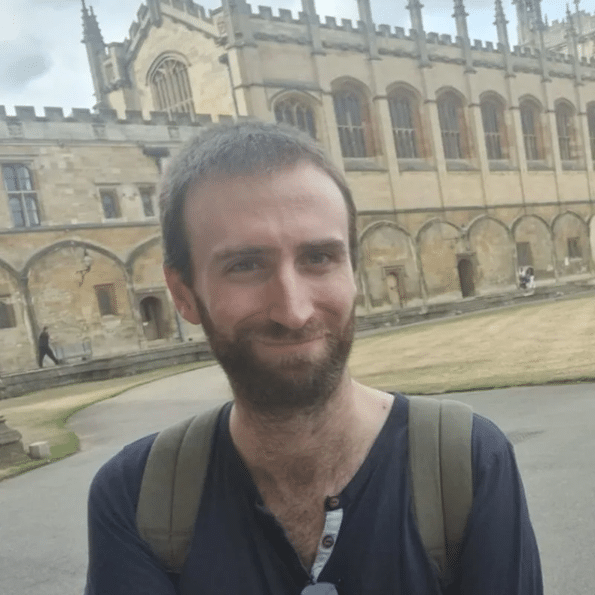
Rich Mayne: My name is Rich Mayne. I’m a postdoctoral researcher at the University of Oxford. I work at the Peter Medawar Building for Pathogen Research and I’m currently funded by the National Institute of Healthcare Research. We are a blood and transplant research unit. Our project is called Gems, which stands for Genomics to Enhance Microbiological Safety – and we’re directed by Professor Peter Simmons.
Emily: Okay. So a lot of acronyms in there. We’ll try to break some of this down. And you’re going to hold my hand through it. Um I, I don’t actually know currently how you would screen blood. So can you just walk me through the process of, like, somebody gives a donation? What happens to it?
Rich: Absolutely. Yeah. So by screening, we just mean looking in the blood for the presence of harmful microbes or what we call pathogens. The World Health Organization recommends that blood services around the world test for at least human immunodeficiency virus. So the causative virus of Aids, hepatitis B virus, hepatitis C virus, something called Treponema pallidum, which causes syphilis and, where relevant, other organisms. So for example, if you live in a malaria prevalence zone, your healthcare service will probably test for malaria as well. Many countries also do travel screening. It gets it gets quite complicated. But most health services just do those.
Emily: And what’s the actual steps of like doing a screening.
Rich: So we tend to look for either DNA in the blood. So DNA from these pathogens, or we look for evidence that the person whose blood is being tested, their immune system is reacting to them. And it’s mostly the DNA tests. We’re probably familiar to the acronym PCR polymerase chain reaction, because that rose to prominence after the Covid-19 pandemic.
Emily: Yeah, I remember having to go and get a swab up my nostril, and they took it away and put it to a lab to tell me that I did or did not have Covid. So how does that then apply to a blood donation?
Rich: So under the hood, it’s kind of the same technology. I mean, we either take a little sample of blood or the fluid that comes off a swab, whatever. We had some chemicals. They sort of dissolve everything in there. That isn’t DNA. We call it extraction. We then go through a process of amplifying very short segments of these bits of DNA, and then we test whether or not they’re present in that sample or not.
Emily: And how effective is that? In general, very, very effective.
Rich: And I’m glad you brought that up, because I really just want to say this, even though our research unit is involved in trying to enhance the safety of blood transfusions, there are currently very, very safe. PCR tests typically can detect as low as one virus per millilitre of blood or even lower than that.
Emily: So what is the downsides then to this technology?
Rich: So I would say the main issue we have with it is when you’re doing PCRs or immunology tests, you kind of only find what you’re looking for. You have to do one test for HIV. You have to do one test for hepatitis C. All of these things, if you’re doing ten of these in a row. That can be quite time consuming. It can be quite expensive. Also, you’re only looking for those things. Our main research focus is on new and emerging threats. So a great example here is Covid. I mean that was a new virus to us at the time. We were not looking for it in existing screening programmes because we didn’t know it was there.
Emily: Well, how would you know what to look for? It was brand new. It just came on the scene and completely changed the world.
Rich: Exactly. And we like to contrast this with the concept of emerging threats as well. This is where we know something exists, but the context is changing. So a good example of this is things like dengue fever that’s spread through mosquito bites. Now due to climate change, the mosquitoes that carry this are migrating further north. So there’s a lot of North European countries that are now considering screening for dengue fever in their blood donors.
Emily: And so you are looking into the future and working on a new technique. This is what we’ve been using in the past. What is so different about what you guys are trying to do.
Rich: So we champion the use of something that we call quite broadly genomics. So that’s the study of an organism’s complete set of genes and ideally also how they function and how they interact. The main technology that we use to study whole genomes is called next generation sequencing.
Emily: I’m going to make like a Star Trek joke. It sounds a bit like Star Trek: The Next Generation. Is that the vibe?
Rich: It’s absolutely the vibe, yeah. Many of us Star Trek fans, we really enjoy the idea of Doctor Bones’ tricorder. We just jab something in your arm, it goes beep boop and it says, yep, you’ve got alien malaria.
Emily: I like that’s where we’re going for the future. So how are you trying to make this tricorder happen?
Rich: So next generation sequencing has been around for quite a while now. I think the first sort of major study using it came out around about two thousand and eight, where it was used to study whole human genomes, but it was really just a research tool. Um, the statistic I always remember it cost about ten million pounds per genome to study at the time. Here we are nearly twenty years later, and it costs significantly less than one thousand pounds per whole human genome now. So that’s a ten thousand times price decrease. And we’ve also had huge decreases in the amount of time it takes to sequence as well. And with this sort of greater economy of scale that we get, we can now apply the technique to study viruses and bacteria and parasites and things that might live in our blood, where previously this wasn’t so easy because we’d expect a majority of a blood sample to just be human genetic material.
Emily: So walk me through this. What exactly are you doing?
Rich: We start out with our blood sample, and the first process is essentially the same as a conventional PCR test. We dissolve away a bunch of stuff that we don’t want in the sample. We then add our chemicals, which sort of smashes all the DNA up into very, very small chunks. We’re talking One hundred and fifty nucleotides long.
Emily: A nucleotide is like teeny, teeny, teeny teeny teeny teeny teeny tiny.
Rich: Absolutely minuscule. Yeah, yeah, the basic building block of DNA. So when we’ve got our smashed up DNA, we then add some more chemicals, and then we stick it in a large machine called a sequencer. We kind of then go and have a cup of tea. We wait a couple of hours, and then it just gives us this giant data file out the other side, which sort of splits each individual chunk of DNA up into into a unit that we call a read. And we can expect there to be up to twenty million of these reads per sample.
Rich: The job that we then have is, what do we do with these millions and millions of chunks of DNA? And this has been, in my opinion, one of the things that’s really held back large-scale implementation of genomic technologies, the lab techniques are actually now quite well established. But the computer analysis that we do after that, something we call bioinformatics, that’s not evolved at quite the same rate.
Emily: I don’t really know what bioinformatics is. They’re going to have to explain that to me.
Rich: Sure. So bioinformatics is just the use of computing technologies to analyse biological data. So in this case we get this file which is just these millions of reads. And this is where my job comes into its own. My job is essentially to write software to make some sense of it. So the main software product that we’ve been involved in developing has been mainly me and our theme leader, Professor Tanya Glodzik. We’ve developed a piece of software called Castanet. This is we call it a platform and sample type agnostic software solution, which is a very fancy way of saying you can stick in any sample type you like sequence with any kind of sequence you like. It will take all of these little bits of DNA in your sample, and it will stick them together, essentially. It’s like the world’s most complicated jigsaw puzzle. And at the other end, you get a collection of whole genomes.
Emily: And so what’s different to how the current mode of operating is, is that if there was something there that you didn’t recognise or could potentially be suspicious. It would almost be red flagged in the system as opposed to in the current version of testing. You have to know that you’re looking for it in order to find it.
Rich: Yes.
Emily: Wow. I feel like I just, like, went to university or something, and I passed. So obviously this could be mega useful. I mean, where are you at in terms of, like, getting it to any form of scale? Like how quick does it work?
Rich: Oh, that’s a great question. So we’ve only got it in our own labs at a sort of like fairly manual level, our team. So I’m part of the technology team on our grant. Um, it’s me, our supervisor, Tanya. We’ve got two wonderful PhD students, Kai and Caitlin, the PhD students are our absolute lab gurus. It’s quite a long and involved process to do the lab work at this stage. It’s around about two days of lab work.
There’s quite long tea breaks in that at some parts where we put the chemicals in a machine and cook them for a while.
Emily: Necessary tea breaks. Don’t you know? Don’t do yourself down.
Rich: Necessary tea breaks. Yeah, absolutely. Um, so, yeah, we’re looking at around about two days and then we stick it in the sequencer machine. I mean, normally that takes a couple of hours. The software part of that. Then once we’ve got the data, our sort of flagship statistic here is we can do a batch of ninety-six samples and analyse them in two hours.
Emily: Wow. That seems pretty quick to me. But I guess that has to be a case where all the conditions are like absolutely perfect in order for it to sort of sail through that sort of speed.
Rich: Yeah. Yeah, absolutely. So if we’re talking about getting this working at scale, we’d have to assume that we were able to get chemicals from supply companies at an appropriate time. I mean, I keep talking about being prepared for the next pandemic. We must assume that that might not be the case in the next pandemic.
There’s also a whole host of regulatory hurdles that need to be overcome as well. So for example, in the UK there are two advisory committees that guide NHS Blood and Transplant on what tests are allowed to be carried out, and they make sure that they’re all pukka before going forward.
They’re called SaBTO – Safety, Blood Transfusions and Organs [Advisory Committee on the Safety of Blood, Tissues and Organs (SaBTO)] and SACTTI, which is the JPAC Standing Advisory Committee on Transfusion Transmitted Infections. That’s a lot of acronyms.
Emily: You really weren’t joking that you guys really do love an acronym. Um, when you’re working with something like a human blood or an organ, obviously the level of safety has to be probably the highest, uh, that you’re dealing with. What’s it like making sure that safety is at the top of the list when you’re doing all of this work?
Rich: So it’s certainly challenging. I can’t pretend it’s not. Way back in the day before I programmed computers as part of my main job. I was a biomedical scientist in the NHS, and I was lucky enough to just sort of get used to it. Then, even though the UK donor population is one of the safest in the world, we kind of have to assume that every single blood sample is potentially hazardous to us as workers. So lots of nylon lab coats buttoned up from your throat down to your knees, two sets of gloves in some cases hands in in large sort of air boxes. But a huge part of this is not just protecting ourselves. It’s protecting the samples from us. The technique is very, very sensitive to the degree that an inexperienced operator might sneeze or even just hold their face slightly too close to the sample, and they can get a whole bunch of genetic material from them into the sample. So it’s a really, um, technically and physically demanding task.
Emily: I don’t doubt it. I mean, you’re obviously looking into the future quite a bit with this next generation sequencing. When do you think we could see something like this being able to be rolled out? Are we, like, decades away, years away, months away? Give me a ballpark here.
Rich: So, technically speaking, this technology actually is prevalent in clinical practice in some parts of the world, just in very, very niche application fields. And really nice example of this is the study of drug resistance in certain bacterial infections. Textbook example is Mycobacterium tuberculosis. As the name implies, that organism tends to cause tuberculosis in people.
Really, really difficult organism to treat because it develops resistance to antimicrobial drugs very quickly. So in order to guide treatment, laboratories will do a huge range of testing on the genomes of these bacteria. Not so long ago, we used to have to do forty or so individual PCR tests, looking at every individual gene that could be present that could cause antimicrobial resistance. Certain countries I know for a fact that Australia’s public health laboratories are now doing next generation sequencing, and it rolls all of these forty tests into the one, and it saves them a huge amount of time and money.
I see that as being the real route towards getting genomics technologies in other laboratories around the world, because once you’ve got a specialist unit for Mycobacterium tuberculosis, you can then build that out to other things as well. So the screening of donated organs or blood is a really nice example of that crystal ball gazing. I really hope this will be in the next decade.
Emily: This podcast was brought to you by Oxford Sparks from the University of Oxford, with music by John Lyons, and a special thanks to Rich Mayne.
Tell us what you think about this podcast. We are on the internet at Oxford Sparks or go to our website, OxfordSparks.ox.ac.uk.
I’m Emily Elias. Bye for now.