How can we use AI to make drugs?
Wednesday 17th Jun 2026, 12.30pm
Put simply, most drugs work by binding to a protein and altering how they function. But how can we model how well a particular molecule will bind to a particular protein, and use that knowledge to help discover new treatments? In this episode, we talk to Prof Fergus Imrie from Oxford’s Department of Statistics, who is one of the lead researchers on the OpenBind consortium. This project aims to create the world’s largest open-access dataset of protein-ligand interactions, providing invaluable quantities of data for AI-driven drug discovery.
[music]
Emily Elias: Drugs take a long time to develop. There’s a lot of work that goes into making sure they can do what they claim to do. But could AI help researchers find a shortcut? On this episode of the Oxford Sparks Big Questions podcast, we’re asking: how can we use AI to make drugs?
Hello, I’m Emily Elias, and this is the show where we seek out the brightest minds at the University of Oxford, and we ask them the big questions. And for this one, we have found a researcher who’s after a lot of data to cure a lot of diseases.
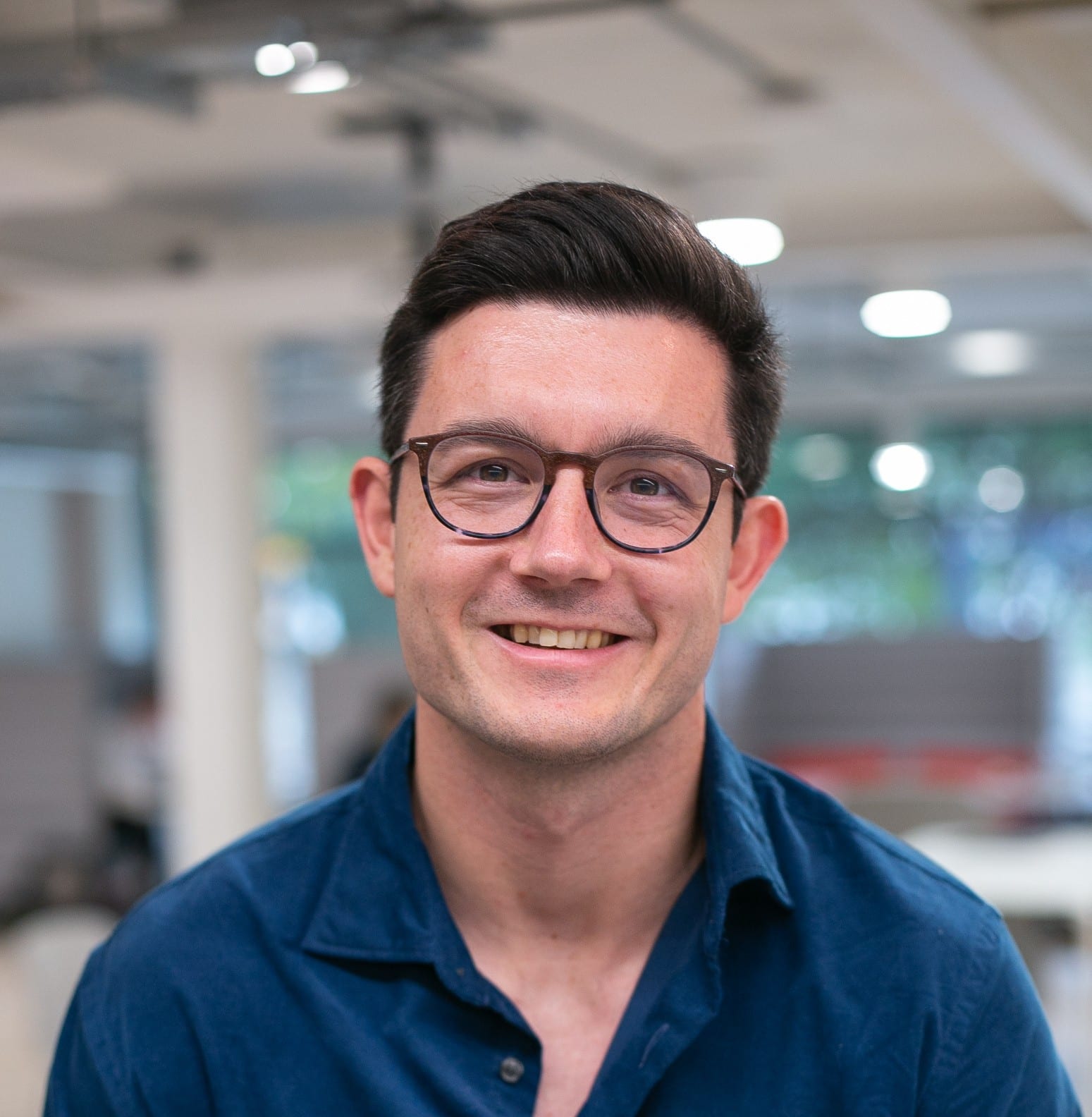
Fergus Imrie: My name is Fergus Imrie, and I’m an Associate Professor in the Department of Statistics at the University of Oxford and one of the lead researchers on the OpenBind project.
Emily: Okay, so you’re looking at using AI to help make drugs. Before we get too far into the context of how these two worlds come together, can we just start with looking at diseases? What exactly is a disease?
Fergus: So a lot of disease really comes down to biology not really behaving as it should. And one of the key biological units that’s really central to this are proteins. So proteins are the kind of tiny molecular machines that are in our cells. So they kind of cut things, they build things, they signal, they move around important cargo and nutrients. When these are all working great, we’re healthy and our body is kind of humming along and doing great.
Emily: But what happens when these aren’t all working together and our body isn’t humming around doing all great?
Fergus: Exactly. So when proteins are missing, maybe they’re overactive, they’re being blocked by another protein, we’ve maybe suffered a random mutation, or we’ve been hijacked by a virus. This is what typically leads to disease states. And so this is obviously kind of a massive oversimplification. Diseases are typically much more complicated than this. But I think this is a really useful way to think about kind of what a disease is, especially in the context of drug discovery.
Emily: And so then we have a disease. Then what does the drug do to the disease, to the protein?
Fergus: So most drugs work by kind of binding to a protein and changing what that protein does or how it’s operating. So sometimes, if we have, let’s say, an overactive protein, that drug serves to block the protein and reduce its effect. So to reduce the number of copies of that protein that are in our body that are working. So instead of it being overactive, it’s now operating more at a normal level. In other cases, if, let’s say, that protein is blocked, the drug could come in and actually activate that protein such that it’s now doing its function all over again. And in other cases, you might kind of change its shape or stop it interacting with another protein. And so these effects can get quite complicated quite quickly. But effectively, drugs work by coming along and interacting with our proteins and kind of changing or modulating their function to do more of the function that we want them to do, and less of the function that we don’t want them to do.
Emily: So in a really, really, really basic way, it’s kind of like proteins plus drugs equals normal, healthy person.
Fergus: Exactly. I think that’s a great way of thinking about it.
Emily: Okay. So then how does AI come into all of this, this world of protein plus drugs?
Fergus: So I think across all kind of worlds, we’ve seen these kind of massive advances in AI, and kind of biology and chemistry and medicine is certainly no exception. And so probably the biggest change that we’ve seen in the last five or six years is that we now have much better tools for actually predicting the structure of these proteins, so kind of what they look like. So some people might be familiar with a tool called AlphaFold. And this was a huge breakthrough led by researchers at Google DeepMind that shows that AI can actually predict the 3D shapes of proteins with remarkable accuracy. And this has been so successful and was such a breakthrough that actually two of the researchers from this project were awarded the Nobel Prize in Chemistry about a year ago now. This has been a great breakthrough for us to be able to model these protein structures.
Emily: So why is this such a breakthrough?
Fergus: It’s a really big breakthrough because before, if we wanted to study the three-dimensional structure of a protein, to know the three-dimensional structure of a protein with any degree of certainty, we had to go and run an experiment. And these experiments take a lot of time, cost a lot of money. And so eventually we might be able to determine the three-dimensional structure of a protein, but it will take months and a lot of money. Whereas with this predictive tool, within a matter of minutes, you’re able to get a very high-confidence prediction for what this protein might look like.
So modelling how these proteins look and work is one of the key stages actually to designing these drugs. These drugs work by kind of fitting into proteins in the right place and in the right way in order to interact with them. And without knowing how these proteins look, it can be very hard to design the drug that fits into the protein.
Emily: And so that is where the sort of link comes together of using AI to help build the pathway to get towards building drugs to cure diseases faster.
Fergus: That’s the start. So part of understanding biology is understanding how the human body works. And so we need to understand kind of the shapes of proteins because there is this kind of central dogma within biology that protein structure determines its function.
So if we know how these proteins look, we can try and start figuring out actually what they do in the body. We know the role and function of quite a lot of proteins in the human body, but there’s many, many proteins that we don’t know how they work, we don’t know how they operate, and we don’t really know how the human body works in general. And proteins are the key to a lot of this.
Emily: And so what are you working on?
Fergus: So I said we can predict the 3D structure of proteins now, but predicting the protein shape is only part of the story. So in drug discovery, what we’re actually interested in is how these small molecules that are going to become drugs actually bind to these proteins. So questions such as: where does it bind? How strongly does it bind? Does this change the protein shape when it binds? And so this protein-plus-molecule problem is much harder than just predicting the protein shape absent some other molecule that’s interacting with it.
And so where I kind of fit into this is, I think one of the biggest challenges that we have is we have a lot of information about proteins, and we also have quite a lot of information actually about these kind of small molecules, these potential drugs. But what we’ve really been lacking in the field is this high-quality kind of experimental information about the pair: so this protein bound with this particular molecule, and kind of how this combination looks and how strongly do these two things interact.
So we’ve been able to predict the 3D structures of proteins quite accurately because we have this massive expanse of data that’s been collected over decades that has been really successfully utilised by these modern AI tools. But we don’t have the same depth of data for how small molecules, potential drugs, bind to these proteins.
Emily: And so how do you go about getting all of this data?
Fergus: So great question. So this is where the OpenBind consortium that we’ve just recently founded, and that I’m one of the leads on, comes in. So OpenBind is an open science project that’s really trying to actually generate this kind of data. So we’re trying to generate large quantities of high-quality experimental data that models these protein-drug interactions: not only the structure of how protein-drug combinations look, but how strongly they bind. And we want to generate this data such that we can advance and produce the next generation of these AI tools, such that we can not only predict the protein structures in isolation, but we can predict how these protein structures are actually interacting with these small-molecule potential drugs.
Emily: So what kind of diseases are we talking about here?
Fergus: So OpenBind is not a project aiming to just develop a drug for one disease only. What we’re trying to do is actually try and improve the general capabilities of AI models for drug discovery. We’re trying to understand how small molecules bind to proteins in general, not just for one particular protein target. And so ultimately, we want to have better AI models such that we can find treatments and cures for ultimately any disease.
And so this will obviously take time. And so in the short term, we’re naturally generating data around specific protein targets where better modelling could help develop specific drugs for specific diseases. So as an example of this, like last week we just actually released our first dataset for an enterovirus, which is a virus that causes hand, foot and mouth disease. And so that could be one shorter-term application of these AI models we’re generating for a specific disease.
Emily: Parents everywhere will be thanking you for this model. That’s kind of crazy that you can take this sort of concept and apply it so broadly across the whole spectrum of, air quotes, “disease”.
Fergus: I think that’s one of the most exciting developments in AI in the last few years, is the development of these much more generalisable models. I think when AI first came back onto the scene about ten years ago, a lot of the models were developed for very specific, tightly framed problems in areas. And over the last few years, as we’ve started training these models on more and more data, we’ve started to see more of their general capabilities emerge.
So as an example, in this area, while five years ago we might have tried to train these models for a specific protein target once we’d collected some data for that target, much more now these models are aiming to generalise across different proteins. So the data we collect for one protein is actually helpful for predicting another protein. And as we collect more and more data on more proteins, we’re increasing this domain of applicability of these models such that hopefully over time they are applicable to almost any protein we might want to study related to human disease.
Emily: And so what do you think the future looks like if this actually works the way you want it to?
Fergus: So I think in my dream world, OpenBind really helps change how AI for drug discovery is developed, and the models we produce change how drug discovery is done. And so I really hope we can help in this journey towards a much more systematic, data-driven approach to drug discovery. So I hope we can produce AI models that understand these protein-drug interactions better, that can be used to design experiments that are chosen because they’re informative for actually progressing a drug discovery project, not just because it’s an idea someone thinks could work, and ultimately drug discovery campaigns that result in better-quality clinical candidates, faster and cheaper.
Emily: But faster and cheaper, yes, but still very high efficacy because we are talking about drugs going into people, which is really serious stuff.
Fergus: So if we think about the path to developing a drug, we first need to figure out which protein that might be implicated in this disease. We then need to design a molecule that is going to interact with this protein effectively. We then run a whole bunch of tests to try and demonstrate its safety and efficacy, first not in human subjects, across a range of different assays in the lab. And then we go through the process of rigorous human testing before a drug is ever approved.
And so in the short term, AI is really mostly going to help at these earlier stages. So how do we come up with these potential molecules that could ultimately one day become drugs? So it will definitely not replace these kind of experimental, clinical and regulatory processes at all.
These drugs are still going to be tested as rigorously as ever, if not more rigorously than they were before, for their efficacy and safety. But hopefully these models will allow us to get better candidates to take into clinical trials.
[music]
Emily: This podcast was brought to you by Oxford Sparks from the University of Oxford, with music by John Lyons. And a special thanks to Dr Fergus Imrie.
Tell us what you think of this podcast. We are on the internet at Oxford Sparks, or you can go to our website, OxfordSparks.ox.ac.uk, and get in touch. Please, we’d love to hear from you.
I’m Emily Elias. Bye for now.