Hannah Sanderson
Planetary Scientist
Like many planetary scientists, I became interested in space because I wanted to be an astronaut. As a child, I was obsessed with anything to do with space and learnt as much as I could from books, museums and TV shows. The BBC documentary “Wonders of the Solar System” was particularly formative for me because it first showed me the range of worlds that exist within our Solar System. For example, Jupiter’s moon Io is the most volcanically active body in the Solar System because Jupiter’s gravity stretches and squeezes it so extremely throughout its orbit that it melts the moon’s interior!
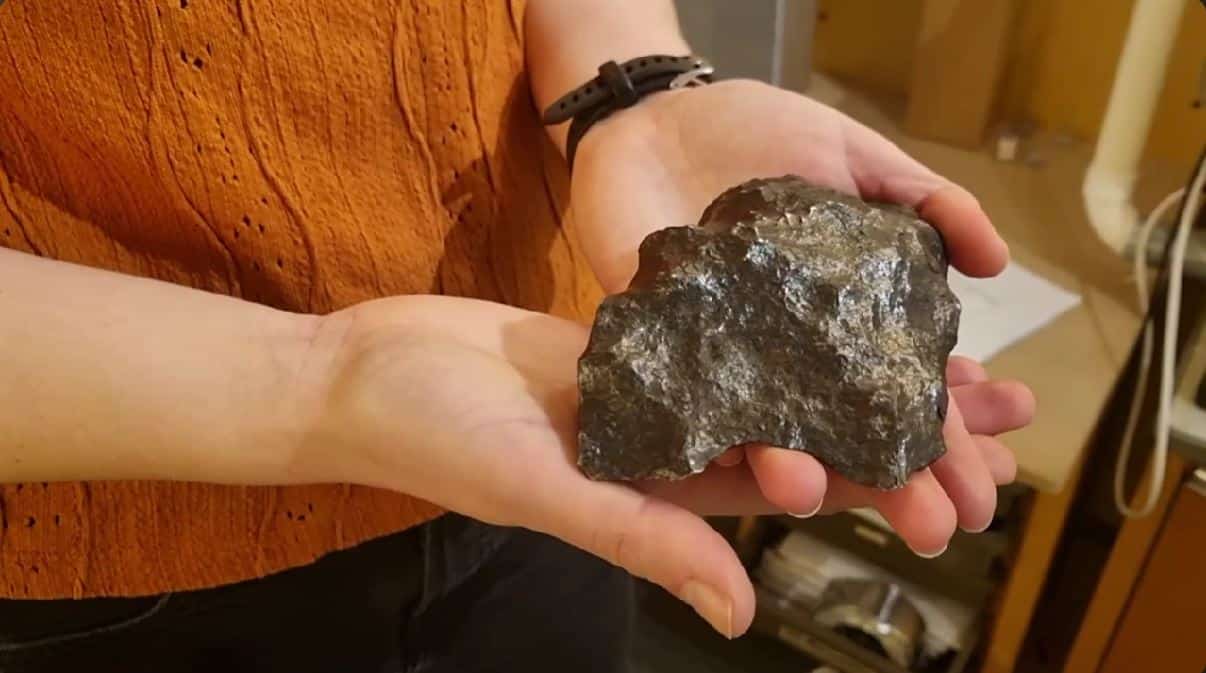
For my undergraduate degree, I studied Natural Sciences at the University of Cambridge, specialising in Astrophysics. My master’s project focussed on detection of exoplanets around stars called white dwarfs – what our Sun will become at the end of its lifetime. While I loved studying exoplanets, for my PhD I wanted to study planets a bit closer to home that we could send spacecraft to and maybe even touch samples from! I’d always been fascinated by the physics of magnetic fields – these things we can’t see but that influence phenomena all around us. The relationship between electric and magnetic fields can also lead to really cool behaviour e.g., wires jumping away from magnets. While in 6th form, I did a summer placement on Jupiter’s magnetic field and then as an undergraduate I did a placement studying magnetic fields of low-mass, rapidly-rotating stars. So, when the opportunity came up to study magnetic fields on planetesimals at Oxford for my PhD, it was the perfect project.
I’ve now finished my PhD and am moving on to a postdoc researching fluid dynamics in magma oceans. Many rocky planets had magma oceans early just after they formed because large planetary embryos (baby planets) colliding together release enough energy to melt rock. I am particularly interested in what happens to any metal within the magma ocean and how it sinking to the core can influence the planet’s magnetic field and its surface and atmospheric chemistry.
When I’m not thinking about planets, I’m probably watching or playing football, climbing or making ice-cream.