How do you build the aeroplane of the future?
Wednesday 3rd Jun 2026, 12.30pm
In 2022, 7% of the UK’s total carbon emissions came from the aviation sector – a figure that’s on the rise. This means that – while a flight is often the start of a well-deserved holiday – a lot of us feel at least a sprinkling of guilt over our carbon footprint. So, what if we could reduce the carbon emissions associated with air travel? In this episode, we chat to Dr Tamsin Whitfield from Oxford’s Department of Materials Science, and hear about her research developing new metals, which will ultimately allow jet engines to burn hotter, increasing their efficiency.
[music]
Emily Elias: Making a jet engine more fuel efficient is not only a great way to save money for airlines, but it also helps out the environment. So how do you go about doing it? Well, you’re gonna need new metals to build it with. On this episode of the Oxford Sparks Big Questions podcast, we’re asking: how do you build the aeroplane of the future?
[music]
Hello, I’m Emily Elias, and this is the show where we seek out the brightest minds at the University of Oxford, and we ask them the big questions. And for this one, we have found a researcher who is making metals.
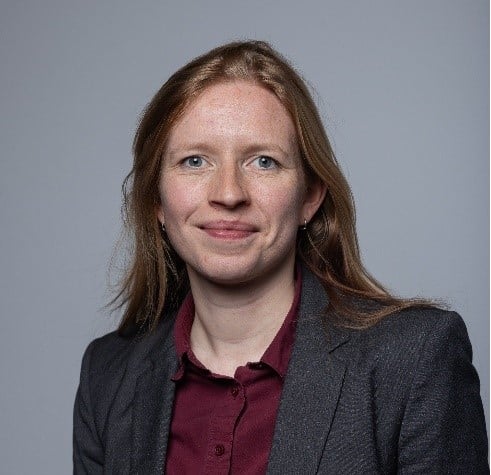
Tamsin Whitfield: Hi, I’m Tamsin Whitfield and I work on the development of new metals, funded by the Royal Academy of Engineering through their Research Fellowship scheme and the Department for Science, Innovation and Technology.
Emily: Okay, so new metals is your sort of world that you’ve been diving into. And today we are talking about aeroplanes. So how do aeroplanes and new metals come together? What is the marriage here?
Tamsin: Okay, so we are trying to make air transport lower carbon. In the UK in 2022, around seven per cent of UK CO₂ emissions was coming from the aviation sector, and that’s projected to grow to around 16 per cent by 2035. And we want to try and maintain our ability to fly all around the world, but to do so more efficiently.
In order to do that, we need to have aeroplane engines that are able to burn fuel more efficiently so they release less carbon. And to do that, we need them to operate hotter, because a hotter engine is a more efficient engine.
However, we’ve got a bit of a challenge at the moment because the materials that are currently within the aeroplane engine, in the hot core of the engine, are operating with a gas flow that’s above their softening temperature. So in order for the aeroplane engines to operate more efficiently and hotter, we need new materials, new metals, to go in that hot part of the aeroplane engine. That would increase their efficiency by around 50 per cent.
Emily: What does that mean, increase their efficiency by 50 per cent?
Tamsin: So it’s increasing the amount of the chemical energy that is going into the thrust, i.e. the propulsion of the aircraft, by 50 per cent.
Emily: So in theory, we’re saving some carbon, we’re saving some money…
Tamsin: We’re saving some carbon, we’re using our fuel better, more efficiently, so that more of the energy that’s stored in that fuel is moving the aircraft rather than just being wasted. That’s going to save money for the airline, and it’s also going to reduce the amount of emissions that end up in the atmosphere and contribute to global warming.
Emily: Your job is trying to make these new materials to make these engines. How do you actually do that?
Tamsin: So when we’re trying to develop a new metal, we’re trying to create an alloy. An alloy is where we mix several different metallic elements together to improve the properties.
The way we go about doing this is a little bit like baking. So we will mix several different elements together and we will melt them together. And then we will put them in an oven, a bit like you would a cake, but we don’t really have a recipe. So we mix them together in different proportions, put them in the oven, and when they come out, we assess whether we managed to make what we were looking for. Does it have the properties that we were looking for? Did we manage to make cake, or did we just end up with biscuits? You might learn from biscuits. You might want biscuits. But if we’re trying to make cake, we need it to have the properties we were aiming for when we put it in the oven.
And it’s an iterative process that we can use some previous data and modelling to inform, but it often requires experiments to test those ideas, to make a new alloy and see whether or not we’ve succeeded, creating a recipe for the material properties that we’re looking at to achieve the strength or the resistance to corrosion by the gas flow at the temperatures we’re interested in.
Emily: So how do you test that you have in fact made a cake and you haven’t made biscuits.
Tamsin: So what we do is that when we have cooked those in our ovens for a while, we take them out. First of all, we look at their microstructure. Now microstructure is what you see down a high-powered microscope.
There are kind of regions of the material on the length scale of about a millionth of a metre, a micron. Within these regions, we have two different kinds of atomic arrangements. In both nickel superalloys, the alloy that is currently used in jet engines, and the materials I work on, atoms are arranged in cubes. But those cubes can come in two kind of different ways. They can either be random, so that within the cube you might have any element on any particular place in that cube, or they can be ordered, so you have atoms at particular places. So, for example, all of the aluminium might be on the corners of the cube.
We can see regions down the microscope of ordered regions and disordered regions. And we want those to be in the right sort of shapes and length scales to give us good strength by replicating this arrangement of ordered and disordered regions of the material that you see in nickel-based superalloys.
Within the materials I work on, we are able to use some of the mechanisms that give them high-temperature strength in the alloys that I’m working on so that we can try and get strength at the temperatures that they will see in the aeroplane engine.
Emily: So how do you do that? Do you, like, make a fake engine using your alloys and then, like, put it to the test?
Tamsin: No. So we’re still a little way off from in-engine testing. Once we’ve had a look at the microstructure, we test various things about it to check that it’s suitable for service. So some of that might be mechanical testing to check it’s got the strength at temperature.
But one of my particular areas of interest is looking at how that microstructure, those regions of ordering and disorder, evolve when you leave them at the sort of temperatures they’d be at in the aeroplane engine for long durations of time. So what I do is I put them in a furnace at those temperatures for a thousand hours or so. And then I look to see whether those regions of ordering are still about the same size or whether they’ve expanded and whether I’m seeing any other changes at a microstructural level that will impact the properties in service.
If we don’t see any changes, then that’s great. And we’ve kind of passed that level of design, and we can then go on to look at other key properties that will be important for these alloys in service.
Emily: So what’s the timescale here? You’re obviously working in a very sort of experimental way. How many years, decades, whatever it is, until we start seeing engines being tested?
Tamsin: Yeah. So typically for a new nickel-based superalloy, the type of alloy we currently use, you’re looking at around five to ten years of qualification once they’ve pinpointed a composition of the alloy that they think is going to be good for it to get into service.
The alloys I work on are novel, and we’re still trying to work out which compositions would be best. My type of alloys have only been studied for around the last ten years, so they’re quite new. So we’re probably looking at at least a decade before these end up in aeroplane engines.
Emily: And why is there such a push to do this type of research? Is it just about saving airlines money, or is there more to it?
Tamsin: So there’s a lot of drive at the moment to improve our carbon emissions. The UK has committed to net zero by 2050, and they have a particular plan in place called Jet Zero to achieve carbon-neutral emissions from the aviation sector. There’s similar legislation going on in Europe with Flightpath 2050. And so it’s really a drive towards sustainability, though also there is interest from companies that build these aeroplane engines too.
Emily: And so what’s giving you anxiety right now? What is keeping you up at night as you’re working on this project?
Tamsin: I think with anything new and novel, you don’t know whether it’s going to work. But there’s a whole range of people from around the world that are working on developing these alloys and looking at different aspects of the challenges to try and come up with solutions. But you never know whether something is going to be viable and actually end up in an aeroplane engine until you get there.
But realistically, in order to produce zero-emission aviation, we’re going to need a combination of approaches anyway. It’s likely to look like use of electric aircraft over short-haul flights, but the energy density, i.e. the amount of weight of a battery for the amount of energy you get out of that battery, is nowhere near as good as burning some sort of fuel. So electric aircraft are likely to only be viable for short-haul. Long-haul flights are likely to need another solution, which is where the materials that I’m working on come in.
We’d like to move away from burning fossil fuels, petroleum-based aviation fuel. So the UK is looking at sustainable aviation fuel, which is based instead on burning biomass, whether that’s based on plants or waste, to enable us to move towards net zero aviation, even if there are still some combustion engines used for long-haul flights.
Emily: Well, I can’t wait to get into a plane of the future.
Tamsin: I Hopefully they’ll be coming soon.
[music]
Emily: This podcast was brought to you by Oxford Sparks from the University of Oxford, with music by John Lyons. And a special thanks to Dr Tamsin Whitfield.
Tell us what you think about this podcast. We’re on the internet at Oxford Sparks, or you can go to our website, oxfordsparks.ox.ac.uk.
I’m Emily Elias. Bye for now.
[music]